

Interwoven Paths
Threads of Yoga. Architecture, Civil Rights and Social Justice


December 6, 2024
I wrote a paper when I was in college in the early ‘90s about the Americans with Disabilities Act (ADA). If you’re not familiar with the ADA, it’s a milestone Civil Rights Act that was signed into law in 1990 by President George H.W. Bush. The ADA provides civil rights protections and mandates that accessible accommodations be provided to individuals with disabilities in all areas of public life- including the workplace, schools, means of transportation, and in all places that are open to the general public. I like to think of it as an extension of the landmark Civil Rights Act of 1964 that established the federal prohibition of discrimination based on race, color, sex, religion or national origin in places of employment, in public accommodations, educational settings and voting booths.
I won’t bore you with the details of that college paper, but to summarize- my major was Architecture and the main context of the paper was supposed to be about the ADA’s impact on the built environment. I fulfilled the assignment, included all kinds of technical information about design and construction, and got an A. (Yay me.) I’ve always laughed to myself thinking the professor probably only read the first 1/3 of that paper. The other 2/3 detailed the many ways in which people with disabilities have historically been discriminated against, and how the ADA is just as significant to the social justice movement as the Civil Rights Act of 1964. The activist in me couldn’t JUST write about technical garble when the ADA was such a momentous victory for social justice! (If my favorite high school teacher [SH] is reading this: Thank you for helping me find my voice and embrace my Wokeness, a quality I’m proud of. I appreciate you and think of you often.)
In 1996, when I started working in the field of Architecture & Engineering, I assumed that the ADA had been integrated into the way that our trade does business. It is the law after all. Without hesitation, I integrated accommodations for people with disabilities seamlessly into my plans. That’s all I knew. I didn’t come up in the profession during a time when accessible accommodations weren’t federally legislated, but I can’t say the same for those that were veterans in the design community at that time.
There was a lot of ADA push-back by boomer generation Architects. They were resistant to change. Rather than prioritize the needs of people with disabilities from the humanitarian perspective, they would often look for loopholes or exceptions to the rules. Designing for the the “average” person with Golden Ratio proportions1 was all they knew, and that’s how it was always done. They would prioritize the needs of non-disabled people by failing to include features such as ramps, elevators, or accessible restrooms. It was never explicitly stated, but they were intentionally excluding people with disabilities from full participation in society. It was discrimination, but it was never talked about in that context - and it bothered me, a lot.
At the risk of a insubordination, I would often implement ADA features into designs that my superiors did and I would challenge their resistance by plainly stating that accessibility inclusion is the law. Many boomers would do anything they could to delay the implementation of accessibility features into the built environment simply because they were resistant to change. Others resisted because their approach toward design was typically motivated by capitalism, prioritizing profits over people, and centering ableism by making the convenience and comfort of the majority their main design objective. Regardless of their motivation (or lack thereof), there was resentment of the ADA and inclusion efforts. Sound familiar?
I didn’t know what it was called at the time, but the resistance to comply was mostly due to implicit biases. Implicit biases (known as Samskaras2 in the Yoga world) are subconscious impressions, prejudices and stereotypes that people develop due to prior influences and ancestral imprints threaded throughout their lives and careers. Individuals are unaware that subconscious perceptions, instead of facts and observations, affect their decision-making. I’m not suggesting design professionals of that era intended to do harm, many simply couldn’t see the forest through the trees. Similar to the white people who outwardly proclaim they don’t have privilege over BIPOC individuals because the term is too triggering for them to sit with and explore. Sitting with, recognizing and naming our implicit biases3 is challenging work, but soooooo worth it.
Some of the Architects and Engineers I knew back in the ‘90s were part of the boomer generation of young, creative, out-of-the-box thinkers who marched with Dr. King and burned their bras. Some of them very proudly talked of their days as college hippies who smoked lots of weed and protested mainstream culture in their spare time. These same people, 30 years later, had no awareness of the Samskaras that imprinted throughout their professional lives. They perceived the ADA as another bureaucratic building code to follow rather than a historic piece of civil rights legislation. It created a challenge to reimagine how they did their everyday jobs after years of things a certain way. Change is hard.
The disabled and BIPOC communities have shared entwined paths of struggle against systemic and structural barriers. Throughout my 30 year career, I’ve observed the evolution of ADA-related civil rights on a steadily upward climbing curve compared to other civil rights movements. The ADA has become an integral part of our institutions and architectural design norms. Most people view accommodations for people with disabilities as a practical necessity rather than a cultural debate, making ADA compliance feel less ideologically charged. There seems to be less resistance to progress when it comes to accessible building spaces compared to other civil rights movements, although the stigma around disabilities and ableism still persist in implicit ways. Not so much in the design community anymore, but to my surprise, it’s prevalent in places of wellness where ableism is often celebrated.
On the connection between the two movements, Disability Rights Michigan noted, “If it weren’t for the civil rights movement, the disability rights movement, and resulting civil rights protections for individuals with disabilities, would probably never have existed. The civil rights movement inspired individuals with disabilities to fight against segregation and for full inclusion under the law. Public institutions would often segregate or exclude people with disabilities from participation in public education, employment, or in using public services, such as public transportation. They took their cues for how to advocate for themselves from Black civil rights activists, many of whom had disabilities themselves.”
Over time, the ADA has normalized changes in physical infrastructure and workplace policies without significant uproar from the masses, while other movements demand broader cultural and systemic shifts. That’s not to say there isn’t capitalistic push-back from corporations when it comes to ADA compliance, but to the design community, it’s second nature- as it should be.
It’s always the rich people and corporations who look for legal loopholes to delay compliance, arguing that ADA compliance is too costly, echoing the resistance seen in other movements when perceived sacrifices to their obscene wealth are involved. If the rich aren’t getting richer, why bother right? (Can you hear my eyeballs rolling?)
The 1964 and 1990 Civil Rights Acts have both faced sharp pushback by capitalism because they present a challenge to the entrenched societal and political caste4 hierarchies that the US is based on.
Both, however, highlight the ongoing struggle for equity and justice in all forms.
Like a lot of people, my most creative thoughts, brightest lightbulb moments and clearest dot-connections happen when I’m driving or in a lucid dream state. Lately I’ve been leaving myself voice transcribed notes on my iPhone when the lightbulbs light up or when dots connect, so I can go back to them. If you don’t do this, try it. It can be enlightening, scary and just plain hilarious to read what your brain dumps out when you aren’t paying much attention. [In hindsight, I probably should have led with this paragraph- but I don’t have an editor. So, here we are, Thanks for sticking around.]
When we’re daydreaming or lucid dreaming, we’re in a restful state where the chatter of our inner voice and the deafening volume of the world are asleep, allowing us to enter a portal to our truth. When we sit with ourselves long enough, questions become answers and the threads of all of life’s moments begin to weave themselves together. Like the pieces that make up a giant quilt, our memories have depth and texture. Some are dark, some colorful and vibrant, some have interesting twists and turns, some have rough patches and some are sort of mundane and uninteresting. They all have meaning, they’re all beautiful and significant, and when they’re connected together, they create a perfectly, imperfect whole masterpiece. Pieces of the past and present are threaded together into a quilt that’s warm enough to hold space for all of it, a quilt that’s just the right weight to keep us grounded, but not too heavy. The pieces become a quilt that’s so expansive there’s no end or beginning, leaving plenty of space for more pieces to be woven into the fabric of the story of our lives.
“… Piece by piece. Part by part. One by one. You welcome your whole self home…” - Octavia Raheem
The other day while I was driving, listening to Jivana Heyman’s Accessible Yoga podcast, I missed more than half the episode because my mind began to wander. I’m not sure which episode I was listening to, but Accessible Yoga, as the name implies, is intertwined with social justice and the rights and civil liberties of all people. It centers the teachings of Yoga around people with disabilities, so it triggered memories of writing that college paper 30 years ago about the ADA. From there, while daydreaming, I started to map the threads of my present life with the past- still an Architect, still someone who puts civil rights and social justice above most things, still someone who despises capitalistic greed. Memories of the imprints that established those core identities and their continuous threads through my rollercoaster of a life took me to the present as a Yoga teacher, teaching at the intersection of Yoga and social justice. It’s all connected.
WE are all connected. We’re just one big community quilt, always in progress, never finished.
The following is the transcript of the voice transcribed note I left myself that day.
All anyone really wants in life is to be included. To be loved. To have access to the same services and spaces as everyone else. We fight against the same capitalist monster generation after generation and that monster tricks us into fighting each other so we don’t pay attention to what they’re doing. When you break it down, all people want is to feel welcome and accommodated. To be who they are in spaces of loving community. People push back on this because it makes them uncomfortable. I think it’s important to look at our implicit biases to figure out why the freedom and inclusion of one population of people makes other groups so intolerant. Why is it so difficult to accommodate others? Why are some people more comfortable continuing with the same patterns of exclusion and hatred that have made them miserable? Change is hard. But if you ask me, whenever anything difficult has come into my life, and I’ve found it to be challenging or I’ve pushed back against it or resisted it, it just shows up, in other ways. Things don’t go away until we face them and work through them. Usually when you look back at something that you resisted changing and clung to even when you knew it wasn’t good for you, all it did was bring more hurt. If you work through it, work with it and not against it… it’s usually on the other side of that work that you feel peace and so much
e x p a n s i o n.
Expansion in the mind, expansion of the way that you see everything… We don’t grow in stagnancy, we grow with change. My work since I was probably 15 years old has been to really open my eyes and see injustices in the world. Whether I can change them or not is irrelevant. For example, world peace- there’s no way that little old me is going to create world peace. I’ve come to realize that my place in all of this is to create peace within myself and, when I see them, to bring injustices to people’s attention. To really see people who have lived on the other side of this privilege that I was born with, in this Caucasian meat suit. I think if we can begin to collectively talk about these things and share our personal experiences with these things and be vulnerable with what our biases are, we can collectively heal and make peace.
A little sprinkle of love here and there can cause a ripple effect. Smile at someone with your eyes, just a little glimmer of kindness might touch someone whose soul needs softening. We have to start looking at how our individual prisons, the individual boxes that we put ourselves in, are only holding us back. They’re only holding society back. They’re only holding back healing and collective understanding. I feel like everything I’m saying is so simple and obvious, but I suppose to a lot of people out there- it isn’t. If each one of us can somehow, some way try to make someone see something through a new lens it might just spark something in their mind that they take through their life and share with others. It’s not gonna happen overnight, but it’ll be worth it. Peace and inclusion might not something we see in our lifetime, but someday it will come. Do you think the greatest civil rights leaders of our time and of previous times, who are no longer on this side of the veil, want us to be trending backwards as a society? If we dig deep and look, the groundwork that those people set is still there it’ll always be there. Nobody can take that away from us. Onward we go.


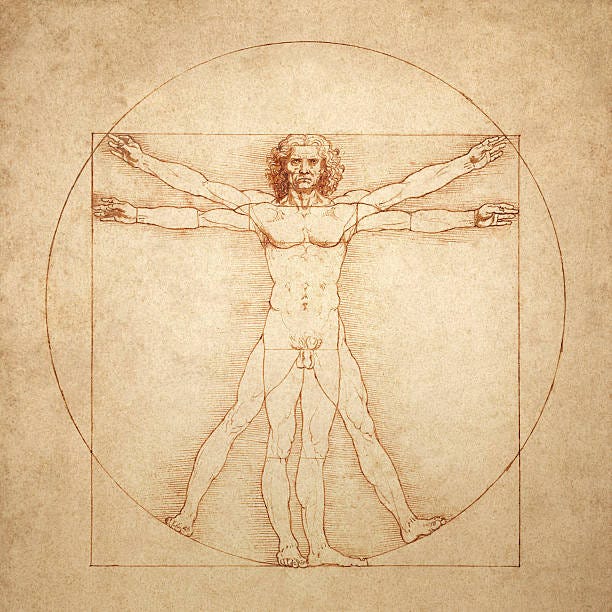
Golden Ratio proportions and numbers have attracted attention from mathematicians, artists, architects, sculptors, musicians and yes, even yogis, for centuries. You may recognize Leonardo DaVinci’s Vitruvian Man in the image below. Many traditional design schools encouraged Architects to design around what Da Vinci’s image depicted as the ideal proportions of the average human body.
I like this explanation of Samskaras by Pandit Rajmani Tigunait:
“Samskaras are the subtle impressions of our past actions…
…the literal meaning of the word “samskara”… The prefix sam means well planned, well thought out, and kara means “the action under-taken.” Thus, “samskara” means “the impression of, the impact of, the action we perform with full awareness of its goals.” When we perform such an action, a subtle impression is deposited in our mindfield. Each time the action is repeated, the impression becomes stronger. This is how a habit is formed. The stronger the habit, the less mastery we have over our mind when we try to execute an action that is contrary to our habit patterns. We all have seen how our habit patterns subtly yet powerfully motivate our thoughts, speech, and actions.
When our habit patterns become so ingrained that they alter our body chemistry, it is called “addiction.” When they become strong enough to alter our thinking process, it is called “samskara.” At this stage we no longer remember when or how this process started. And without introspection or retentive power we fail to discover the realm of the mind where these samskaras are stored. When our mental world is totally under the influence of these powerful impressions they become the determining factors of our personality, and due to these samskaras we perceive this world in our habitual ways.”
If you’re a white person who’s still reading this, thank you. Becoming curious about what implicit bias and white privilege actually mean without becoming triggered is growth. All white people have privilege over BIPOC and LGBTQ+ people. It’s not about wealth or status or overt racism. Merriam Webster White Privilege Definition
If you haven’t read Caste, The Origins of Our Discontents by Isabel Wilkerson, check it out. It’s a masterpiece!

One never knows when seeds are planted if they will bloom. 🤗❤️Thank you for sharing your wisdom and journey, and giving me hope. This is a beautiful piece!💕🙏